Climate change must be recognised as a global health emergency. That is the call from the new Lancet Countdown report, published on 28 October 2026. It is the tenth such report. It was prepared by 146 experts from 71 institutions who track 54 indicators.
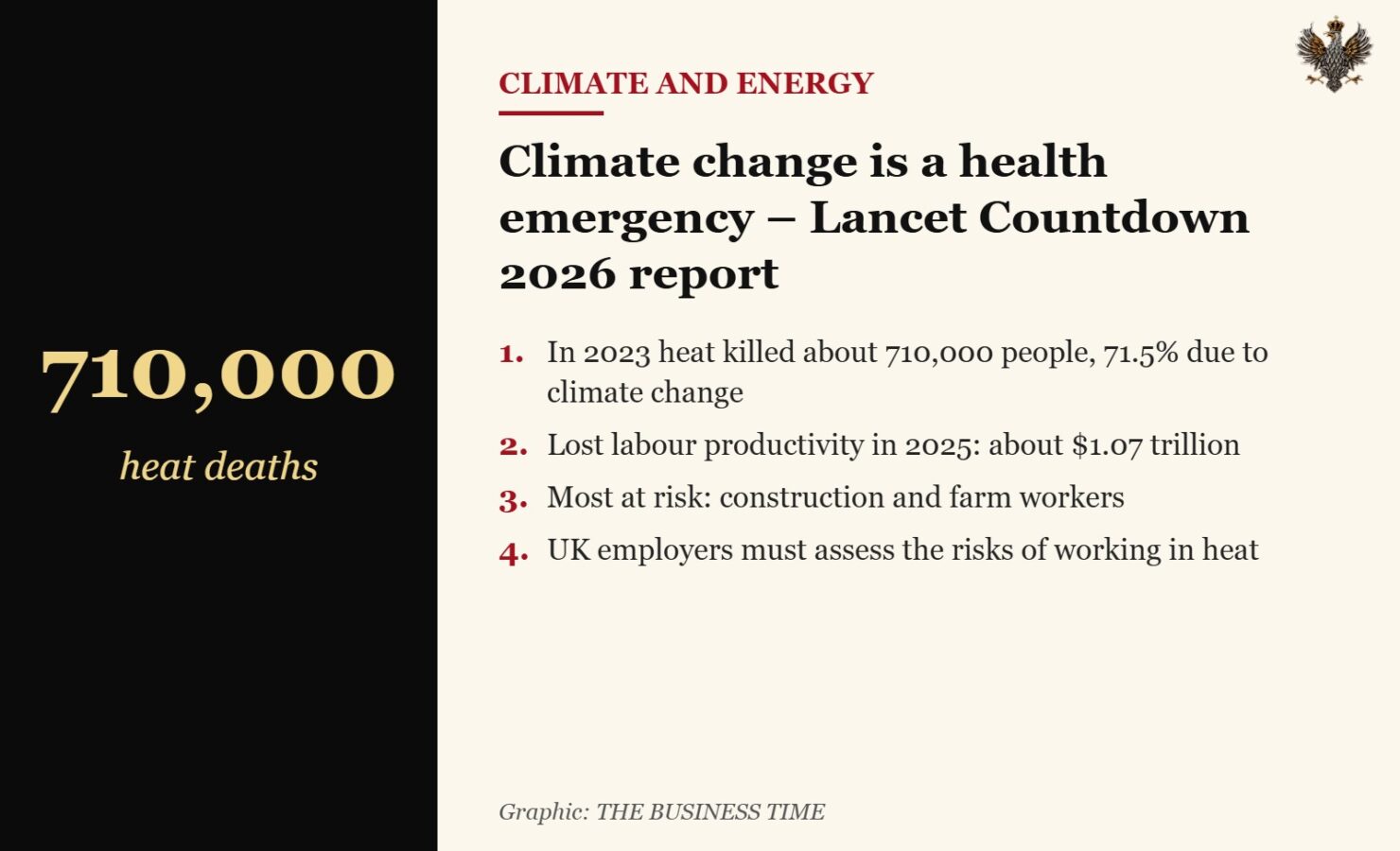
The strongest figure concerns heat. In 2023 about 710,000 people died worldwide because of high temperatures. According to the authors, about 71.5% of these deaths can be attributed to climate change. Between 2016 and 2023 an average of about 540,800 people a year died because of heat, and the share attributable to climate change rose to 68% (in 2006–2015 it was 55%).
Heat also costs the economy. The report estimates that lost labour productivity due to heat cost about $1.07 trillion in 2025. The worst affected are sectors where people do physical work outdoors: agriculture and construction.
The authors also criticise the fossil fuel sector. According to the report, the 100 largest oil and gas companies are on track to produce 150% more fuel in 2040 than a pathway limiting warming to 1.5°C allows. Lancet Countdown executive director Marina Romanello says these numbers point to a “clear emergency”.
A separate European Lancet Countdown report shows that the number of heat-related deaths in Europe is rising in almost all regions. In 2024 it was estimated at about 62,000. Poland is one of four countries for which detailed regional data have been prepared.
What it means for you
For families it is a reminder that heat is a health issue, not just a weather issue. The most vulnerable are older people, young children, pregnant women and people with chronic illnesses. For construction workers, gardeners, drivers and warehouse staff – jobs where many Poles in the UK work – ever hotter summers mean a higher risk of heatstroke and dehydration.
For small businesses it is a cost: slower work in hot weather, breaks, absences and extra equipment. An employer in the UK has a duty to assess risks to workers’ health, including at high temperatures.
Our assessment
The report does not change the law overnight. But such data reach governments ahead of the COP31 climate summit and influence regulations and ESG requirements. We believe that businesses which plan for working in hot weather now will pay less than those that only act during the next heatwave.
What to do
- Follow UKHSA and Met Office heat-health warnings: Heat-Health Alerts on GOV.UK.
- If you run a business, check HSE guidance on working in high temperatures and add it to your risk assessment: HSE – temperature at work.
- Plan for summer: adjust outdoor working hours, provide shade, water and breaks.
- Full results: Lancet Countdown 2026 report.
Sources: Lancet Countdown, 2026 report (28.10.2026); Lancet Countdown Europe, 2026 report; ScienceAlert (28.10.2026).
We assess factual corrections and substantive responses. Verified changes are reflected in our reporting.
Contact the editorial desk →