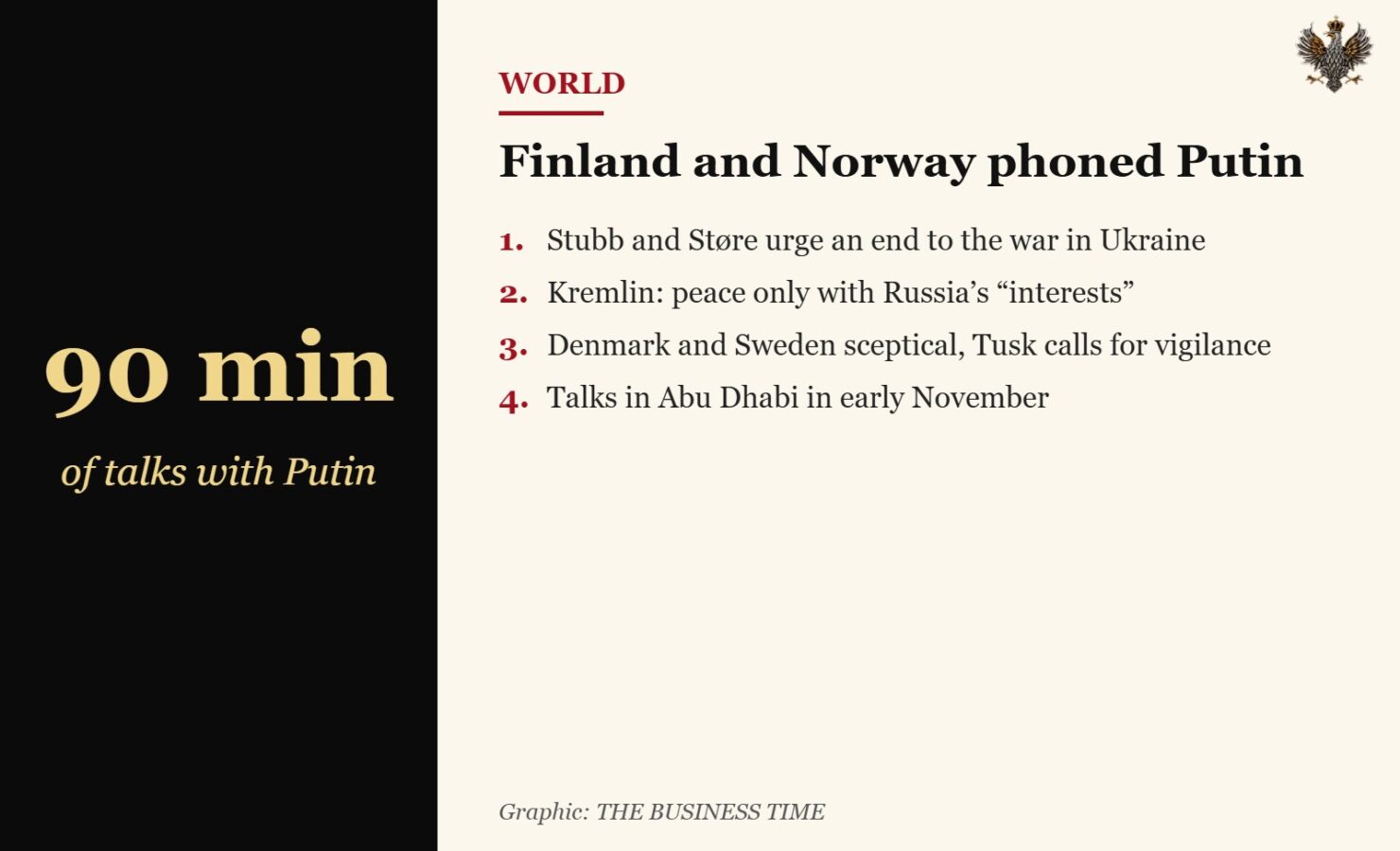
Finnish President Alexander Stubb and Norwegian Prime Minister Jonas Gahr Støre spoke by phone with Russian President Vladimir Putin on Tuesday 27 October 2026. The call lasted about 90 minutes. It is a rare break with the policy of Western leaders, who since the start of the full-scale war in Ukraine have generally avoided direct contact with Putin.
Both leaders urged Putin to end the war and return to peace talks. They said that Finland and Norway – among the largest donors of military aid to Ukraine – would continue to support it. They also discussed security in the Baltic Sea and the High North. After the call they phoned Ukrainian President Volodymyr Zelensky.
Stubb stressed that they acted as leaders of their own countries, not on behalf of Europe as a whole. According to him, the call was prepared in consultation with Ukraine and the US. The Kremlin responded that lasting peace is possible only if Russia’s “legitimate interests” are fully taken into account. Foreign Minister Sergey Lavrov said the call brought nothing new.
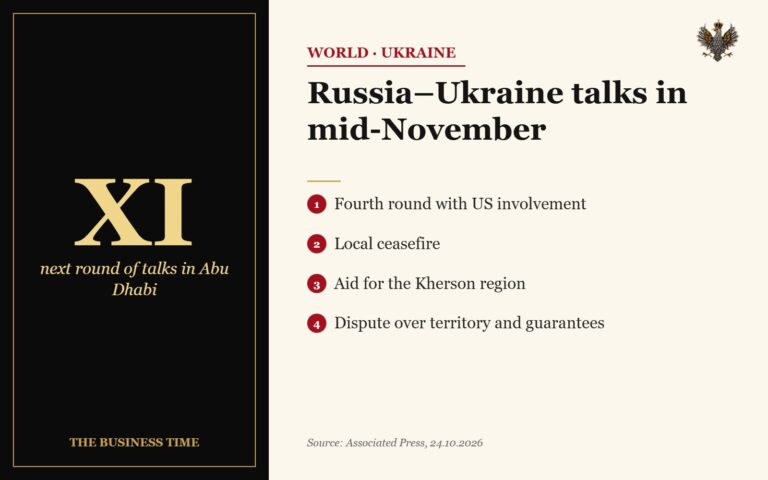
Reactions in Europe are divided. Danish Prime Minister Mette Frederiksen criticised acting “solo”. Swedish Prime Minister Ulf Kristersson spoke of low expectations. Prime Minister Donald Tusk called for absolute caution and vigilance in such contacts. Another round of talks involving the US is due to take place in Abu Dhabi in early November – for the first time in this format with a Russian delegation.
What it means for you
For Poles in the UK and Polish businesses, the war in Ukraine still means energy, fuel and transport prices, as well as uncertainty in trade with Central and Eastern Europe. Every real step towards talks may calm the markets. However, the split in Europe over contacts with Moscow means that a quick peace cannot be counted on. The United Kingdom took part in the October talks in Oslo, so London will have a say in the next stages.
Our assessment
This is not a breakthrough, but a signal that Europe is looking for its own place at the table before the terms of peace are set solely by Washington and Moscow. We believe nothing will change immediately in prices or sanctions. Businesses working with Poland and the Baltic states should plan for a scenario of prolonged uncertainty.
What to do
- Before travelling to countries bordering Russia and Ukraine, check the UK Foreign Office advice: FCDO – Foreign travel advice.
- If you trade with Eastern Europe, check the current sanctions on Russia: UK sanctions on Russia.
- In contracts with business partners, take into account the risk of changes in fuel and energy prices.
Sources: Euronews (27.10.2026); Al Jazeera (28.10.2026).
We assess factual corrections and substantive responses. Verified changes are reflected in our reporting.
Contact the editorial desk →