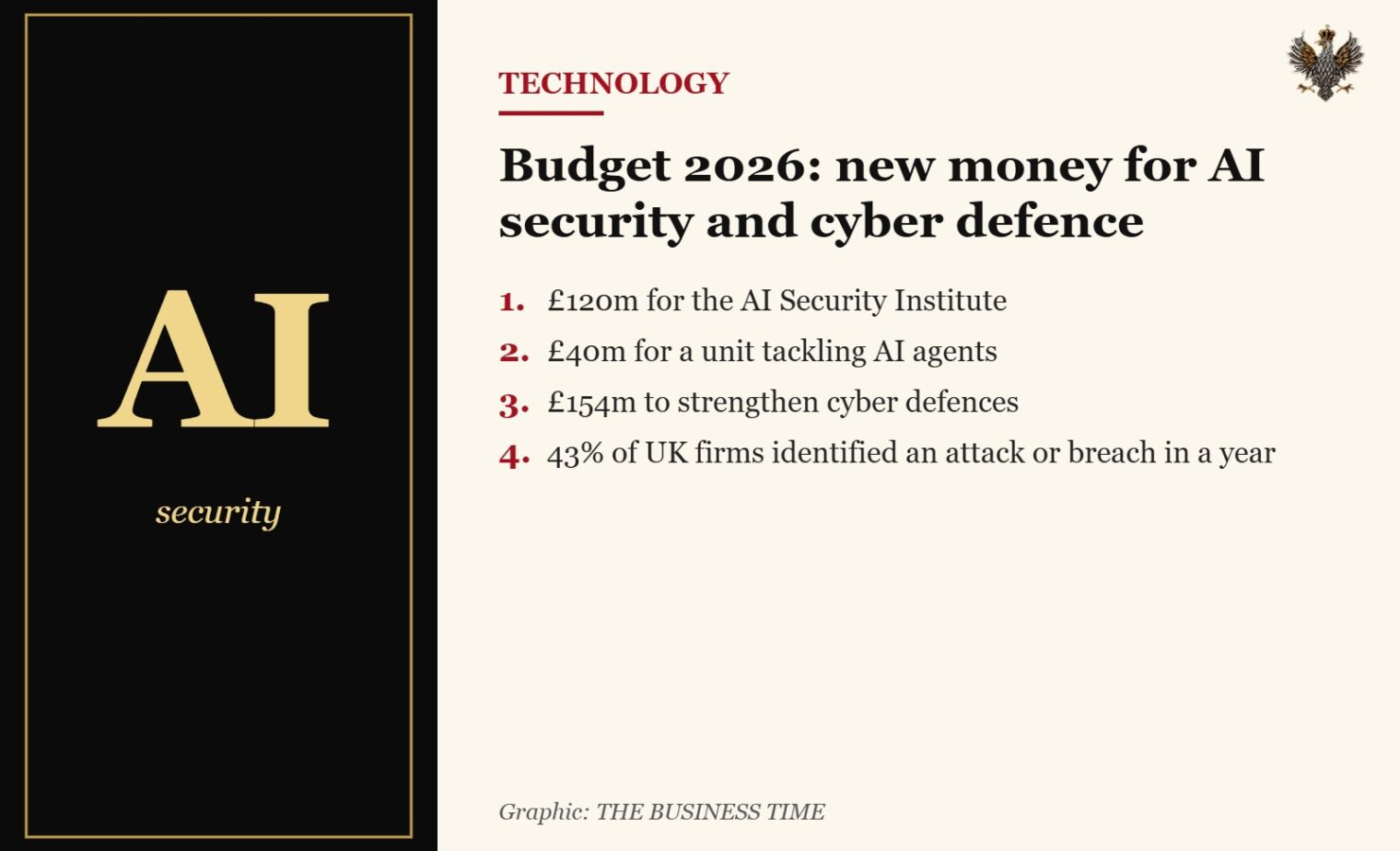
The Budget announced on Wednesday 28 October 2026 by Chancellor John Healey puts new money into artificial intelligence security and cyber defence. The Treasury set out the key figures in the Budget document on GOV.UK.
The AI Security Institute – the government body that tests the most advanced AI models – will receive an additional £120 million. £40 million will go to a new National Agentic Security Unit. It will investigate and respond to incidents involving “AI agents” – programs that carry out tasks online on their own – when they go rogue.
The Budget also provides £154 million to strengthen cyber defences and an additional £140 million for the Sovereign AI Unit, which supports British AI companies and projects. The government also announced new rules for data centres (the Data Centre Covenant). Strategic data centres seeking greater state support will have to meet set conditions.
For comparison: according to the government’s Cyber Security Breaches Survey 2025/2026, 43% of UK businesses identified a breach or attack over the year. Among small businesses (10–49 staff) the figure was 46%, and among micro-businesses 42%. Phishing – fake emails and messages – was the most common (38% of businesses).
What it means for you
The Budget money goes mainly to state institutions, not directly to businesses. But the new units are meant to detect threats faster and warn about them. For a small Polish business in the UK, the key lesson is simple: almost one in two firms encounters an attack, and it most often starts with a single click on a fake link.
Our assessment
The government is focusing on AI security because businesses increasingly use automated assistants with access to email, invoices and accounts. That is the right direction. However, the sums are spread over several years and many institutions, so the effects will come later. Day to day, a firm’s security still depends on the firm itself: passwords, backups and staff vigilance.
What to do
- Turn on two-step login for your email, bank and accounting software.
- If you use AI assistants, check which accounts they can access – and limit that access.
- Take the free “Cyber Action Plan” test and look at the Cyber Essentials scheme on the NCSC website.
- Read the Budget 2026 document on GOV.UK.
Sources: HM Treasury, Budget 2026 (28 October 2026); DSIT, Cyber Security Breaches Survey 2025/2026 (30 April 2026).
We assess factual corrections and substantive responses. Verified changes are reflected in our reporting.
Contact the editorial desk →