Editorial comment. This is an opinion piece. We give the facts we rely on with links to sources.
On Wednesday 28 October Chancellor John Healey will present his first Budget in the House of Commons (UK Parliament). We know the atmosphere well. For several weeks leaks appear in the papers, and the owner of a small building firm in Peterborough or a beauty salon in Glasgow wonders whether to take on one more person or wait. We believe the most important thing in this Budget is not one tax rate. The most important thing is whether businesses finally get a few years of calm.
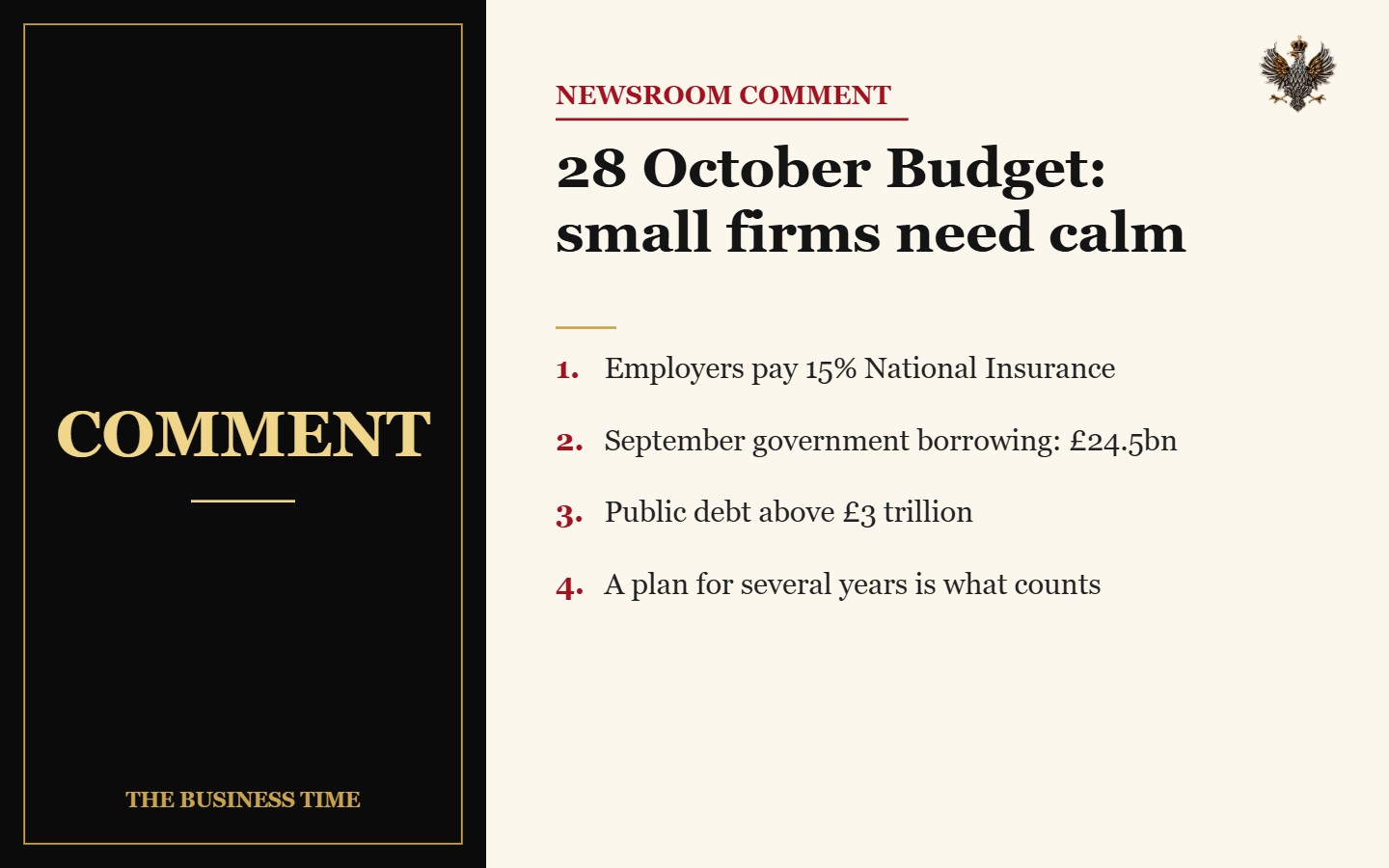
Let us start with what is already costing money. Since April 2025 employers have paid 15% National Insurance, and the threshold from which it is charged has fallen to £5,000 a year per employee. The government raised the Employment Allowance to £10,500 at the time (legislation.gov.uk). For a firm with three or four staff, that relief made a big difference. For a firm with ten people on the minimum wage, the bill still rose markedly. We see it in conversations with our readers: less overtime, more contract work, more cautious recruitment.
The second argument is the state of the public finances. According to the ONS, the government borrowed £24.5 billion in September, £1.9 billion more than the OBR had assumed. Net debt exceeded £3 trillion for the first time, and debt interest alone came to £10.9 billion in a single month (ONS, 21.10.2026). Anyone who runs a business understands this immediately: with numbers like these, the chancellor has no money for giveaways. That is exactly why predictability matters all the more. If taxes cannot be cut, the government should at least say clearly what it will not touch until the end of this Parliament.
The third argument is more human. Healey told The Times he wants to support “stubborn entrepreneurs” (London Loves Business). Very good. Polish entrepreneurs in the UK are, to a large extent, exactly such people. They started with one van or one barber’s chair. They do not need grand programmes. They need one page on GOV.UK that says what is changing and from when, and the certainty that there will not be another revolution in six months.
To be fair, there is another side. A government with a hole in its finances may decide that stability is a luxury. Some will say it is better to raise taxes quickly now than to keep borrowing for a country our children will pay for. That is a serious argument and we do not dismiss it. But firms that do not know what next year will bring do not invest or hire. And without that, tax receipts will not grow either.
Our conclusion is simple. On Wednesday we will look not only at the numbers but at whether the chancellor gives small businesses a plan for several years. If he does, many of our readers will finally dare to hire. If not, it will be another year of waiting. After the Budget we will write about exactly what changes for your business and your pay.
THE BUSINESS TIME Editorial Team
We assess factual corrections and substantive responses. Verified changes are reflected in our reporting.
Contact the editorial desk →