Update 28 October 2026, 10:32: During the debate on 27 October, the government announced wider protection for leaseholders against repair costs. The number of properties up to which an owner is protected for defects other than cladding is set to rise from three to six. The government also wants to help people who bought a flat after 14 February 2022 as their only home, and residents of buildings they jointly own themselves – there will be new money for them to fix internal fire-safety defects. Product manufacturers are to contribute more. For now these are proposals – the details will be added to the bill during its passage through Parliament. Source: GOV.UK, MHCLG (27 October 2026).
On Tuesday 27 October the House of Commons will consider at second reading the government’s Building Safety (Remediation of Unsafe Cladding etc) Bill. It is a response to a problem that, since the Grenfell Tower fire, has affected thousands of residents of blocks of flats in England – including many Poles who bought flats on a leasehold basis.
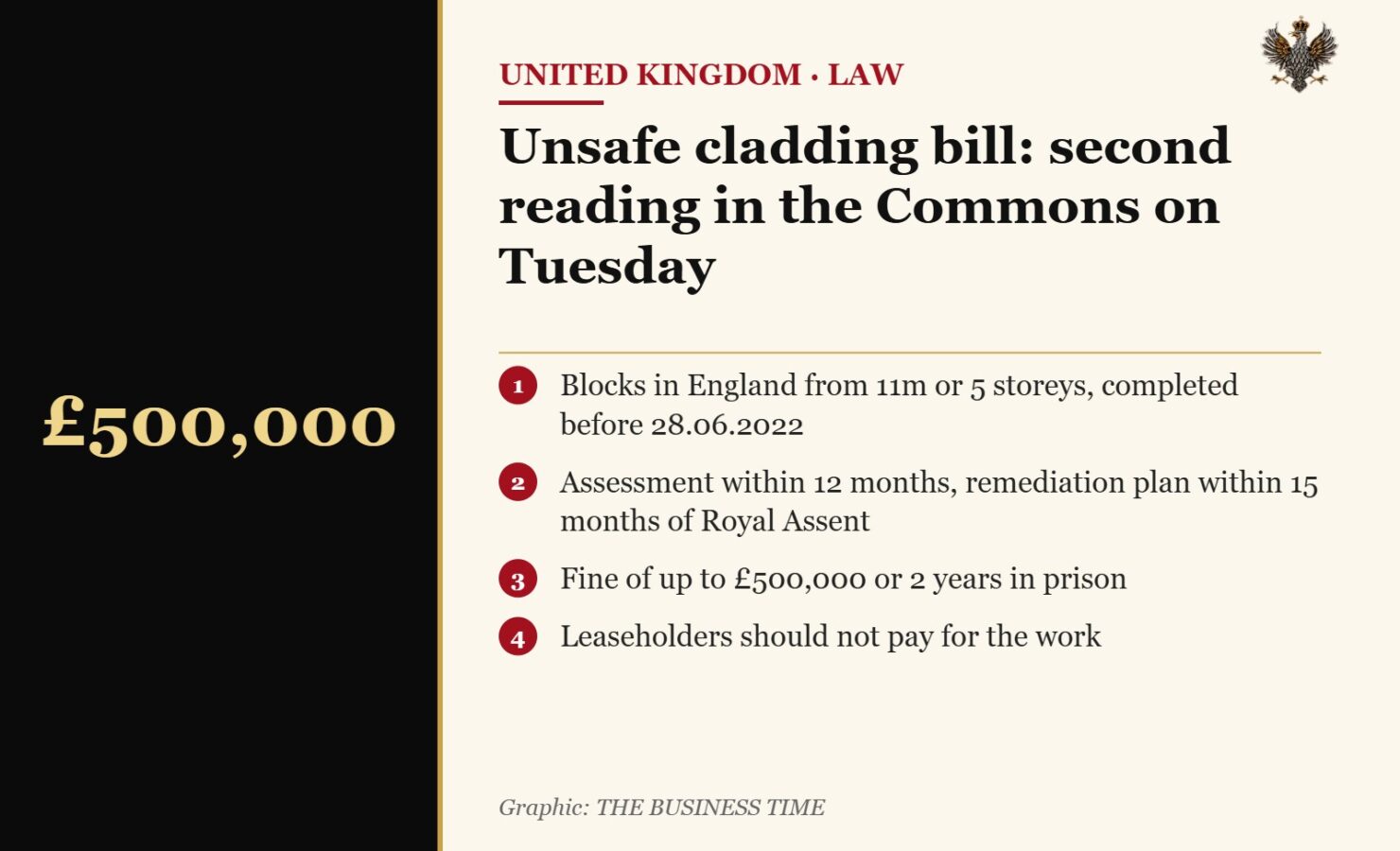
According to the guide from the Ministry of Housing (MHCLG), the bill introduces a legal duty to assess and remove dangerous cladding. It applies to residential buildings in England with at least two flats, taller than 11 metres or with at least 5 storeys, completed before 28 June 2022. It covers both private and social housing.
Deadlines run from the day the bill becomes law (Royal Assent). The duties will apply after 2 months. The assessment of external walls will have to be completed within 12 months, and a remediation plan submitted within 15 months. A special register will be created for buildings between 11 and 18 metres high.
The penalties are high. Deliberately failing to carry out remediation can lead to up to 2 years in prison or a fine of up to £500,000. Obstructing the authorities – up to £40,000 for an individual. As a last resort, a council or Homes England will be able to take over management of the remediation through a tribunal.
The government has set aside £5.15bn for remediation. The bill is also intended to make it easier to recover money from manufacturers of dangerous construction products.
What it means for you
If you own a flat in a block with cladding, the most important point is that, according to the government, leaseholders should not pay for work covered by the new duty. The building owner will not be able to pass penalties or the costs of the remediation plan on to them. The cost limits from the Building Safety Act 2022 also remain in place. For Polish construction and facade firms, it signals extra work in the coming years.
Our assessment
The bill has the backing of a government with a large majority, so it will most likely pass. However, this is only the second reading – the committee stage, the House of Lords and Royal Assent are still ahead. The first firm deadlines will therefore start running next year at the earliest. For residents it is good news, because it ends the situation in which nobody feels responsible for the repairs.
What to do
- Ask your building manager whether an external wall assessment (FRAEW) has been carried out and what the remediation plan is.
- Keep correspondence and bills for service charges related to cladding.
- Read the government’s guide to the bill on GOV.UK.
- If you run a construction business, follow tenders for remediation work and the requirements of the PAS 9980 standard.
Sources: GOV.UK / MHCLG – Guide to the Building Safety (Remediation of Unsafe Cladding etc) Bill (updated 23 October 2026), UK Parliament – Coming up in the Commons 26–30 October.
We assess factual corrections and substantive responses. Verified changes are reflected in our reporting.
Contact the editorial desk →