Comment by THE BUSINESS TIME editorial team.
On Tuesday, the UK Defence Secretary Wes Streeting was in Warsaw. Together with Polish Defence Minister Władysław Kosiniak-Kamysz, he announced the Warsaw Defence Plan – the first phase of cooperation under the UK-Poland Security and Defence Partnership Treaty. On the same day, the Polish government said Poland will get a service centre for PAC-3 MSE missiles for the Patriot system. Most of us will read this as news for the military. We believe it is also news for Polish businesses operating in Britain.
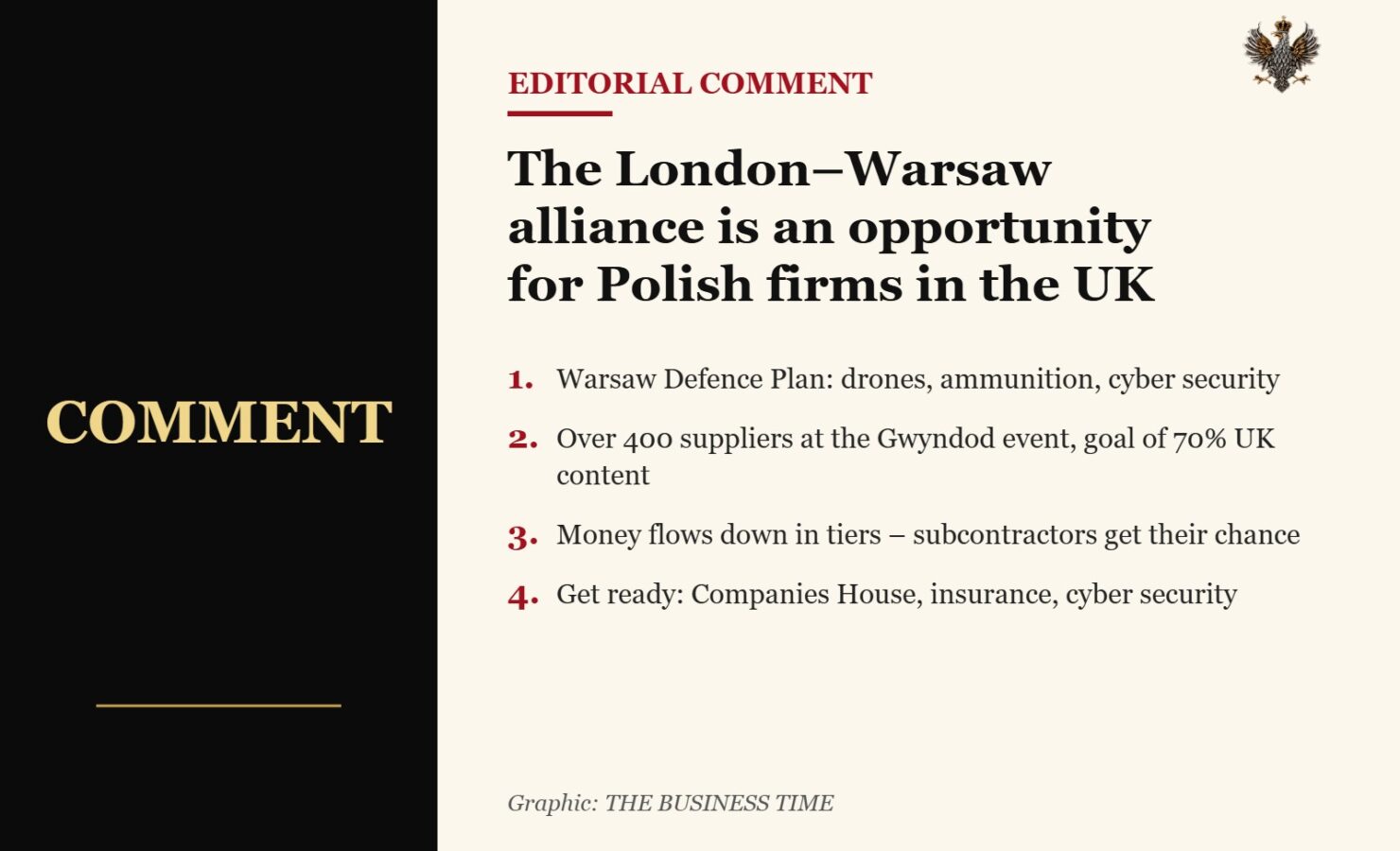
Why? First, the plan does not stop at exercises. According to the UK Ministry of Defence BAE Systems and Poland’s PGZ are to expand large-calibre ammunition production, and the two countries want to jointly develop drones, counter-drone technology and cyber security, including for civilian sites. Projects like these need more than engineers. They need transport, translators, training, servicing, logistics, IT and people who understand both markets. We see that these are exactly the services in which Polish businesses in the UK are strong.
Second, we have a fresh example of how this works in practice. In the same week, Great British Energy – Nuclear brought together more than 400 suppliers on Anglesey who want to work on Britain’s first small modular nuclear reactors. The goal is 70% of the project’s content from UK-based companies, and small firms received tailored advice on how to join the supply chain. A company registered in the UK, even if it is run by a Pole, counts as a British company in that calculation.
Third, the bridges work both ways. Kosiniak-Kamysz described the Patriot centre as the first stage towards producing Patriots in Poland. A firm with an office in London and contacts in Poland can be a natural intermediary for British contractors looking for partners in Poland.
We know the counter-argument and take it seriously. Defence procurement is slow and demanding. You need certificates, security measures, often security clearance, and contracts go to the big players first. The location of the service centre has not yet been chosen, and the minister himself speaks of many months of work. A small firm will not sign a contract with a ministry next week. That is true.
But no sensible person is suggesting that. Money in programmes like these flows down in tiers: from the main contractor to its suppliers, and from them to smaller subcontractors. At the third and fourth tier, the door is open to anyone who is prepared. Preparation starts with simple things: up-to-date details at Companies House, proper insurance, a basic cyber security certificate and attending supplier events.
Our conclusion is short. The London–Warsaw alliance will last for years. Polish businesses in the UK can watch it on the news or start preparing for it now. We recommend the latter.
THE BUSINESS TIME editorial team
We assess factual corrections and substantive responses. Verified changes are reflected in our reporting.
Contact the editorial desk →