Updated: 25.10.2026, 15:43.
Mariusz Gabriel B.
publisher of THE BUSINESS TIME, CEO of ARGONAUTS MEDIA GROUP, in the B2B database business since 1991
I read “The Complete Tokenization Process”, an e-book by the Luxembourg firm Tokeny, the way I read a contract before signing: sentence by sentence, asking what it means for the client and what the author left out. It is a good, factual guide to how a security becomes a token. It is not, however – and does not pretend to be – an analysis of the legal risks in the UK. I add that part below.
In brief
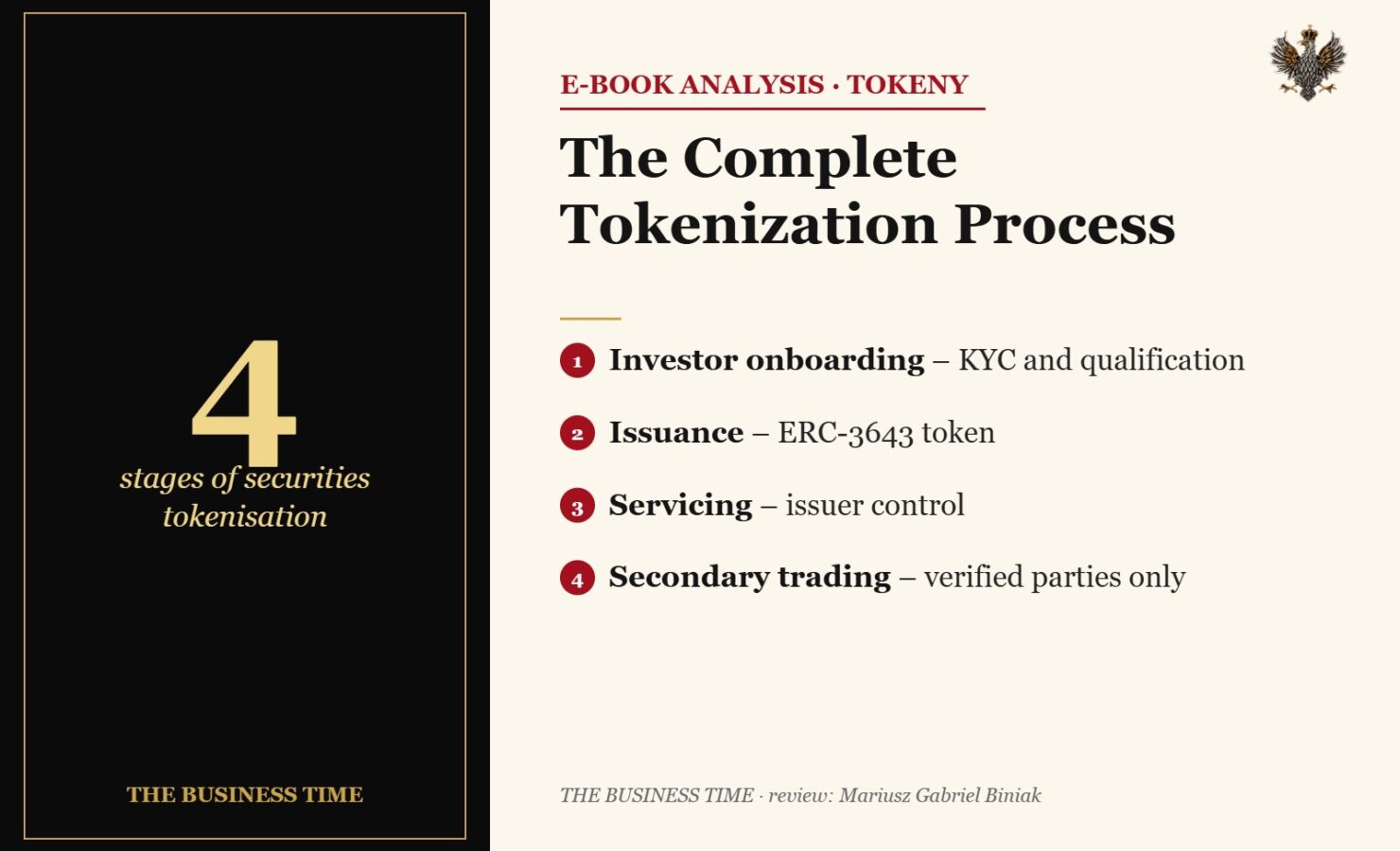
- What it is: a 15-page Tokeny guide (2023 edition) to the full life cycle of a tokenised security: investor onboarding, issuance, servicing and secondary trading.
- Who wrote it: the creator of the ERC-3643standard, a “token with built-in rules”. Since May 2025 Tokeny has been majority-owned by Apex Group – an administrator of more than $3.5 trillion in assets.
- The key idea: compliance is written into the token itself. A token can only go to a verified investor – whatever platform it circulates on.
- What is missing: a real assessment of UK regulations, of risks for investors and up-to-date data. The figures in the e-book date from 2023.
Who Tokeny are – the facts
- A Luxembourg company, creator of the ERC-3643 standard and the T-REX platform for issuing tokenised securities.
- The e-book (2023) states: 6 years in operation, $28bn of tokenised assets, more than 100 issuers. In 2025 CoinDesk was already reporting more than $32bn.
- May 2025: Apex Group acquires a majority stake in Tokeny, with a plan for full acquisition within three years. Apex’s first investment – December 2023.
- March 2026: Apex announces that the T-REX Ledger network (built on Polygon) will be its default infrastructure for distributing tokenised funds. The target: $100bn in assets by June 2027.
What the e-book describes – four stages
The token life cycle according to Tokeny
1. Investor onboarding. Identity verification (KYC) with AI assistance, an assessment of whether the investor may buy the security, an electronic signature and payment – in currency or in “tokenised cash”.
2. Issuance. Deploying an ERC-3643 contract with rules: who may be an owner, how many investors there may be and from where. The investor receives an ONCHAINID digital identity, and the shareholder register updates in real time.
3. Servicing. The issuer and its agents can mint and burn tokens, pause trading, freeze a suspicious investor, force-transfer tokens and recover them for an investor who has lost access to their wallet. Plus subscriptions, redemptions and investor communications.
4. Secondary trading. A bulletin board for investor-to-investor transactions, centralised exchanges, DeFi protocols (e.g. loans against tokens as collateral), decentralised exchanges and OTC markets – always only between verified investors.
The market – where we are in October 2026
- According to the RWA Foundation, tokenised real-world assets (excluding stablecoins) were worth about $39bn on 9 October 2026 – about 81% more than at the start of the year ($21.5bn). Other services count differently: from $31bn to $47bn.
- J.P. Morgan settles an average of $7bn a day on its Kinexys network, and on 19 October it launched the JPM Coin deposit token on Ethereum.
- Kinexys head Oliver Harris warns, however: “tokenisation is not liquidity”. The best technology will not create buyers if there are none.
For comparison: the securities market is measured in hundreds of trillions of dollars. Tokenisation is still a fraction of a percent – growing fast, but from a low base.
Regulation in the UK – what the e-book leaves out
The e-book talks about a “jurisdiction-agnostic” platform. The technology may be agnostic. The law is not. In the UK a simple principle applies: a token that is a security is subject to the same rules as a security. Technology does not change the nature of the instrument.
- A security in token form is, in the UK, an investment supervised by the FCA (FSMA 2000). Issuing, offering, arranging and safeguarding require permissions or exemptions.
- Financial promotion: inviting people to invest without approval by an FCA-authorised firm is a criminal offence in the UK (section 21 FSMA).
- Public offers: since January 2026 a new public offers and admissions to trading regime (POATRs) has applied.
- The Digital Securities Sandbox of the Bank of England and the FCA – in May 2026 there were 16 firms in it. It supports the government’s pilot of a digital gilt, DIGIT.
- Funds: on 30 April 2026 the FCA issued PS26/7 rules for tokenised authorised funds. A blockchain record can be the primary register of transactions.
- On 18 May 2026 the FCA and the Bank of England set out a joint vision for the tokenisation of wholesale markets. The Bank wants to launch a settlement synchronisation service in 2028.
- The FCA’s new cryptoasset regime (from 25.10.2027) concerns cryptoassets, not tokenised securities – those remain under existing financial instrument rules. The same applies in the EU: MiCA does not cover financial instruments.
Through an investigative journalist’s eyes – what is not in the e-book
1. “Exempt from licensing in most jurisdictions”. That is how the e-book describes the bulletin board for investor-to-investor transactions. In the UK, merely bringing together parties to securities transactions may amount to “arranging deals” requiring FCA permission. This has to be checked for the specific model, not assumed.
2. Decentralised exchanges without an MTF licence. The e-book suggests that with a certain structure a trading venue licence will not be needed. In the UK such a claim requires a legal opinion – the regulator looks at the function, not the name.
3. Issuer control. Forced transfer, freezing and pausing tokens are compliance tools – and an advantage for the regulator. For the investor they mean one thing: you trust the issuer and its agents, not “blockchain mathematics”. That is fine, as long as you know who holds the keys and on what legal basis they can use them.
4. Data from 2023. The e-book is marketing material from before the Apex acquisition. Its figures and product names must be read with that date in mind.
Risks
| Risk | Affects | Level |
|---|---|---|
| Liquidity – no buyers on the secondary market | investors | HIGH |
| Wrong legal classification and operating without permission | issuers, platforms | HIGH |
| Dependence on the issuer and agents (keys, permissions) | investors | MEDIUM |
| Technology risk and cyber attacks | everyone | MEDIUM |
| Personal data protection (KYC, digital identity) | issuers, investors | MEDIUM |
What it means
For a Polish business in the UK considering an issue: tokenisation can lower investor servicing costs and shorten settlement. But before you choose a platform, establish with a lawyer what your token is, which permissions are needed and who will be responsible for what.
For investors: a token with built-in compliance is safer than an anonymous cryptocurrency, but it is not safe by definition. Ask about the issuer, the governing law, the custodian, how to exit the investment and who can freeze your tokens.
How to prepare – an issuer’s checklist
- The legal classification of the token (security, fund unit, cryptoasset) – in writing.
- FCA permissions, or cooperation with a firm that has them (issuance, arranging, safeguarding, promotion).
- An offer document compliant with the public offers regime, or a documented exemption.
- KYC/AML and data protection procedures – personal data kept off the public blockchain.
- Clear rules for using control functions (freezing, forced transfer, token recovery).
- A realistic liquidity plan – who will buy, and where.
What to watch
- The FCA and Bank of England joint roadmap for tokenising wholesale markets.
- The DIGIT digital gilt pilot.
- The FCA consultation on distributed ledger technology in capital markets (announced for 2026).
- Whether Apex meets its target of $100bn in tokenised assets by June 2027.
My assessment
As a guide to the process: 9/10. Clear, complete, and a good demonstration of how tokenisation with built-in rules works.
As a source on risks and UK law: 5/10. A technology vendor’s material – it is no substitute for a legal opinion.
Worth reading before you start talking to an adviser. Not worth making decisions on without that conversation.
Mariusz Gabriel B.
Sources
- Tokeny – “The Complete Tokenization Process” (e-book, ©2023 Tokeny Sàrl) – the document analysed
- CoinDesk – Apex Group acquires majority of Tokeny (20.05.2025) – secondary source
- Finance Magnates – Apex: $100bn target by 2027 (19.03.2026) – secondary source
- Bank of England and FCA – joint vision for tokenisation (18.05.2026) – primary source
- FCA – PS26/7 Progressing fund tokenisation (30.04.2026) – primary source
- FCA – Digital Securities Sandbox – primary source
- FCA – new cryptoasset regime (30.06.2026) – primary source
- J.P. Morgan – JPM Coin on Ethereum (19.10.2026) – primary source
- Benzinga – tokenised assets: $39bn (13.10.2026) – secondary source
We assess factual corrections and substantive responses. Verified changes are reflected in our reporting.
Contact the editorial desk →