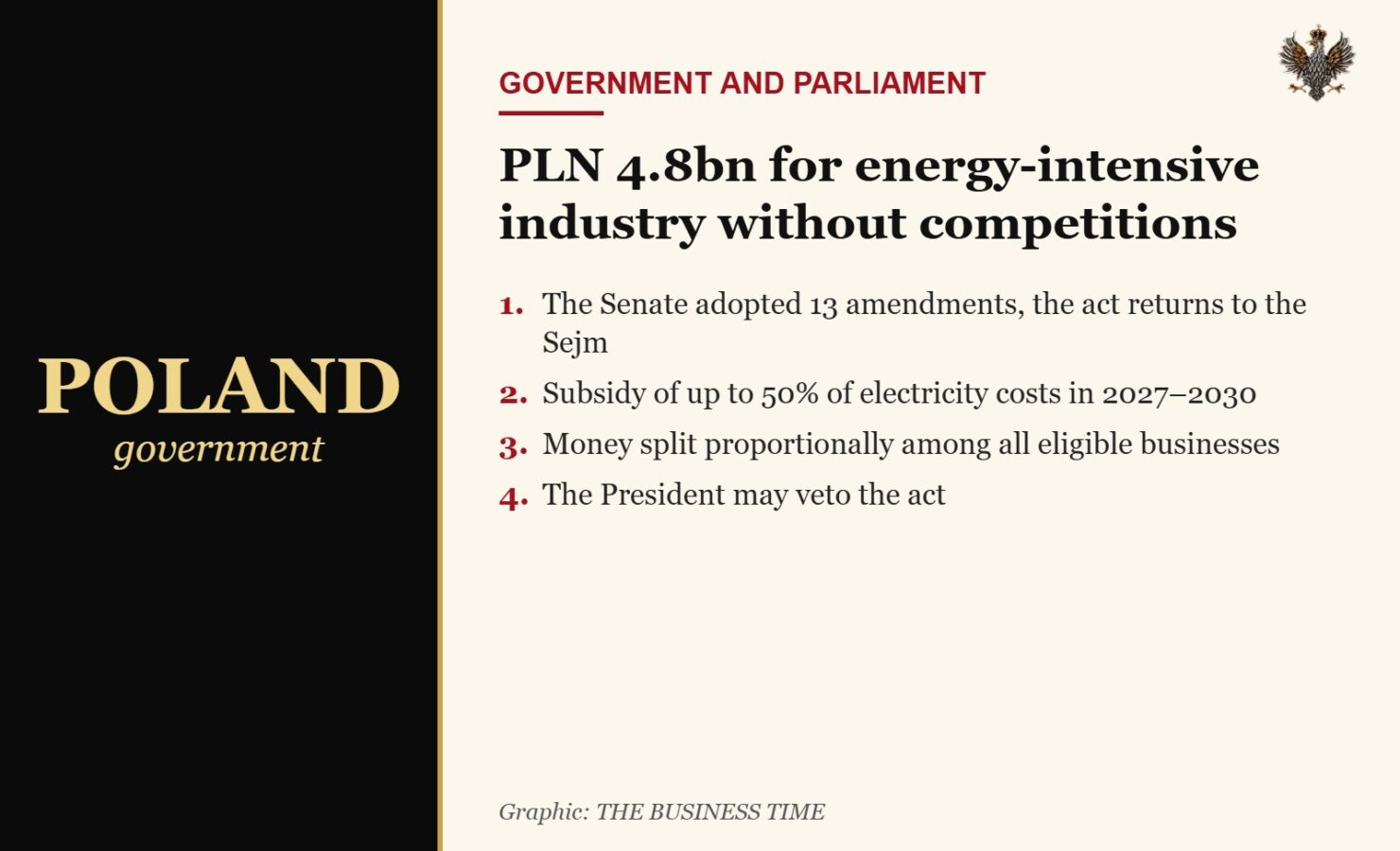
Aid for the businesses that use the most electricity will not be allocated through competitions. On Tuesday, the Senate adopted amendments to the act on support for businesses in energy-intensive sectors. The act now returns to the Sejm.
The scheme is worth PLN 4.8bn for 2027–2030: PLN 800m in 2027, PLN 1.6bn each in 2028 and 2029, and PLN 800m in 2030. It is based on the EU’s CISAF state aid rules. The subsidy can cover up to 50% of electricity costs, and the price after the subsidy cannot fall below €50 per MWh. Businesses must invest at least half of the money in green energy and energy efficiency.
The Senate adopted 13 amendments, mainly tabled by Senator Waldemar Pawlak. Instead of a competition, the money will go proportionally to all eligible businesses. If there are more applications than money, support will be reduced equally for everyone. Businesses also no longer have to name a specific investment in the application. According to Rzeczpospolita, Energy Minister Miłosz Motyka says the changes were agreed within the government after talks with industry.
The scheme is to be financed by a temporarily higher CIT for fuel and energy companies: 30% in 2027, then 26% and 23%. The Senate rejected amendments that would have removed this increase. Unofficial signals from the Presidential Palace suggest that President Karol Nawrocki may veto the act, although dropping the competitions improves the chances of his signature.
Steelworks and heavy industry welcome the change. The Steel Industry Chamber (Hutnicza Izba Przemysłowo-Handlowa) warned that under competitions only a few of the largest businesses would receive money, while around 350 are eligible.
What it means for Poles in the UK
If your business in the UK sells steel, chemicals, glass or services for industry to Poland, your Polish customers may get cheaper electricity from 2027 and more money for investment in renewable energy. This is an opportunity for orders, e.g. for installing renewable systems and energy storage.
Our assessment
A proportional split is simpler and fairer for medium-sized businesses. The weakness is that with many applications, subsidies may be low. The biggest risk is a presidential veto, because the dispute is about the CIT increase, not the aid itself. We expect this to be settled in November.
What to do
- If you work with Polish industry, ask your customers whether they plan energy investments in 2027–2030.
- Follow further work on the act on the Sejm website.
Sources: Rzeczpospolita (rp.pl) (28–29 October 2026); WNP.pl (28 October 2026).
We assess factual corrections and substantive responses. Verified changes are reflected in our reporting.
Contact the editorial desk →