Sponsored article · Partner: DATABOT.PL
In this guide
- How the rules differ in the UK and Poland – in plain words
- Whom you can email in the UK without consent, and whom you cannot
- How to write the subject line, body and sign-off
- The most common mistakes that send emails to the bin
Cold emailing means a message to a person or business that doesn’t know us but may need our service. It is a cheap way to win new B2B customers – on one condition: we write to the right people and within the law.
United Kingdom: companies yes, sole traders – with care
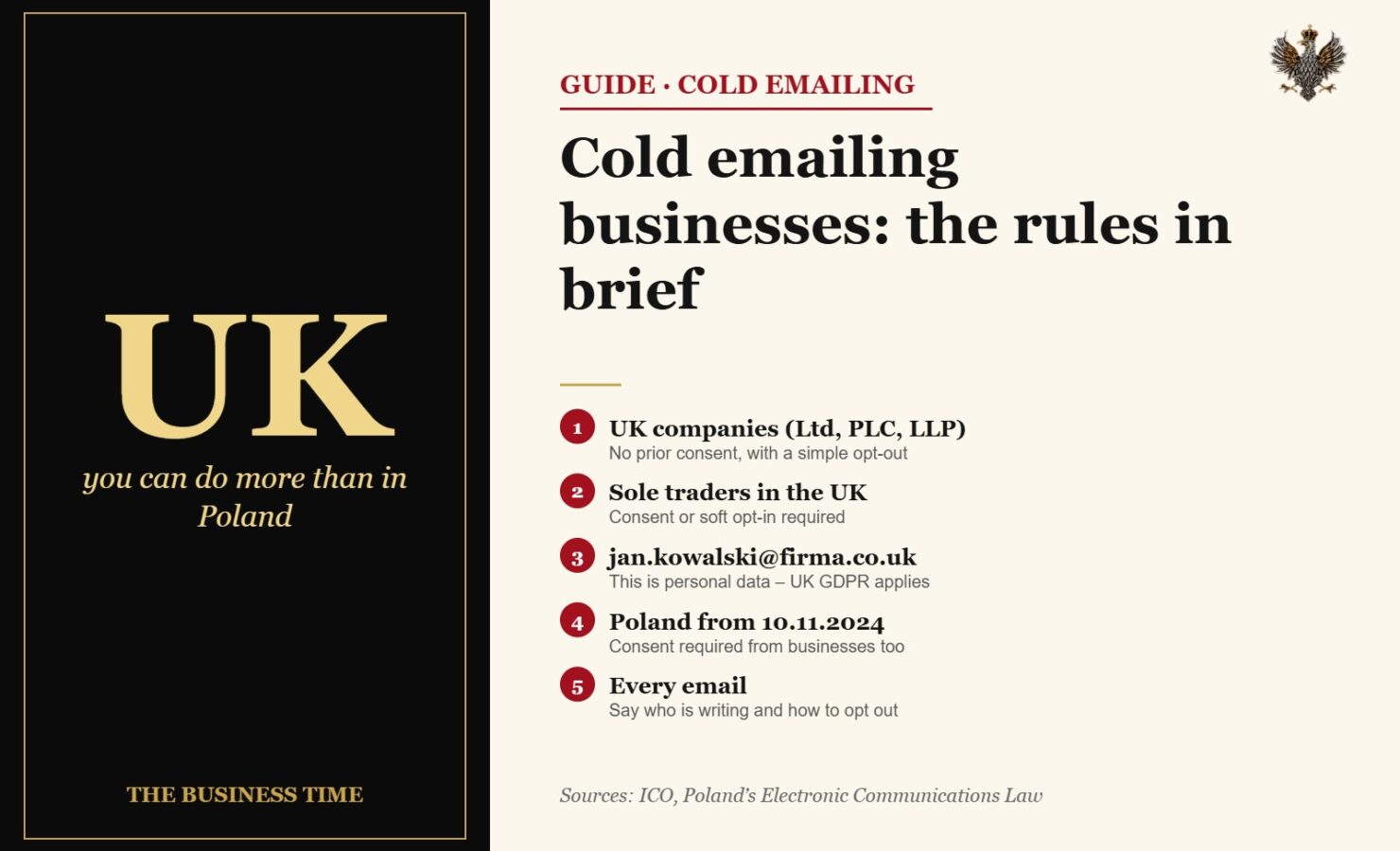
According to guidance from the UK data protection regulator, the ICO, marketing email to so-called corporate subscribers – companies (Ltd, PLC), LLPs and Scottish partnerships – does not require prior consent. You must, however, clearly say who is writing and offer a simple way to unsubscribe. Unsubscribe requests must be respected and a “do not send” list kept.
It is different with sole traders and some partnerships. The ICO treats them as individuals: you need consent or the so-called soft opt-in (e.g. past or current customers to whom you offer similar services). If you don’t know whether an address belongs to a company, treat it as an individual’s address.
Note: an address such as [email protected] is personal data. UK GDPR then applies – you need a lawful basis (usually “legitimate interests”) and must inform people about the processing. The ICO notes that following the Data (Use and Access) Act its guidance is under review and may change.
Poland: not without consent – businesses included
Since 10 November 2024 the Electronic Communications Law has been in force. Article 398 prohibits sending commercial information by email without the recipient’s prior consent – and this also applies to businesses. Consent must be separate for each channel (email, phone). According to Prawo.pl, the President of UKE can impose a fine of up to 3% of revenue or up to 1 million zł. The same provision also covers telemarketing. In practice, in Poland it is better to start with a meeting, a trade fair, a referral or LinkedIn – and only then ask for consent to send an offer.
How to write an email someone will answer
1. The right recipient. The best message achieves nothing if it reaches the wrong person. First check who in the company makes purchasing decisions.
2. The subject line. Short and specific, tied to the customer’s need – not to your company.
3. The body. A few sentences, plain language, a benefit for the recipient. They should feel you are writing to them, not to a thousand companies.
4. One goal. The first email doesn’t sell. It aims to get a reply: a short call or permission to send an offer.
5. Patience. Several messages are often needed – each one different, not a copy of the last.
Editorial comment
For a Polish business in the UK this is good news: you can make first contact with British companies, provided you do it honestly and with an unsubscribe option. But when you send offers to businesses in Poland, much stricter rules apply. The same campaign can be legal in London and illegal in Warsaw.
What to do
- Split your list into companies (Ltd, LLP) and sole traders – write to the second group only with consent.
- In every email give your company name, address and an unsubscribe link. Keep a list of people who have unsubscribed.
- Do not email offers to businesses in Poland without prior consent.
- Write 3 short, different messages instead of one long one.
- If in doubt, ask a lawyer – this article is not legal advice.
About the partner: DATABOT.PL is a B2B company data platform operating in Poland, the United Kingdom and Europe. More: www.databot.pl

Mariusz Biniak – creator of the DATABOT.PL platform and author of a blog on B2B sales. This article is based on his guide, edited and updated by THE BUSINESS TIME Editorial Team. Disclosure: the author is connected with the newspaper’s publisher.
What do you think?
Do you feel this in your business? Tell us in the comments below the article. We will cover the most interesting views in future editions.
Sources
- ICO: Business-to-business marketing
- Prawo.pl: Marketing consents and business contacts – Electronic Communications Law
- DATABOT.PL: Cold mailing (original guide)
© THE BUSINESS TIME / Argonauts Media Group Limited and DATABOT.PL. Sponsored article. Copying, downloading and distribution without the publisher’s written consent are prohibited. This is not legal advice.
We assess factual corrections and substantive responses. Verified changes are reflected in our reporting.
Contact the editorial desk →