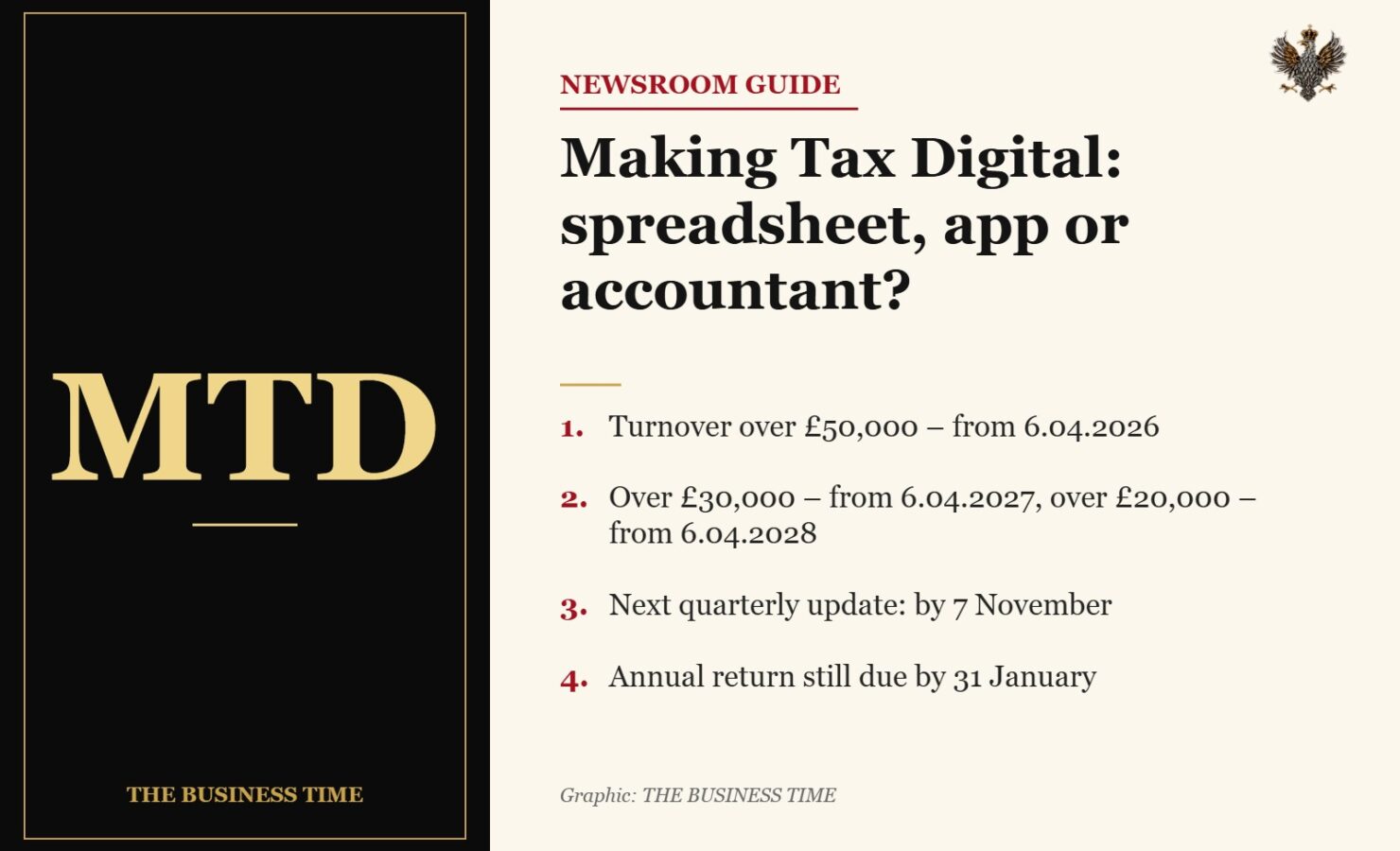
Making Tax Digital for Income Tax (MTD) is a new way of doing Self Assessment. It applies to the self-employed (sole traders) and people who let property. From 6 April 2026 it covers those whose combined turnover from self-employment and property – before costs – exceeded £50,000. From 6 April 2027 the threshold will be £30,000, and from 6 April 2028 – £20,000. HMRC estimates that MTD covers more than 864,000 people in its first year.
The problem
Instead of one return a year, you must keep digital records (the amount, date and category of every income and expense item) and send a quarterly update every three months. Deadlines in the 2026/27 tax year: 7 August 2026, 7 November 2026, 7 February 2027 and 7 May 2027. The annual return for 2026/27 is still due by 31 January 2028. HMRC does not provide its own software – you must use MTD-compatible software.
In the first year HMRC does not give penalty points for late quarterly updates, but they must be sent before the return is filed. From the second year each late update earns one point, and four points mean a £200 penalty.
Possible solutions
1. On your own, with simple MTD-compatible software. Pros: full control, low cost, entries on the go from your phone. Cons: it takes time and you need to understand expense categories; mistakes are your responsibility.
2. An accountant or agent who sends updates for you. Pros: less stress, lower risk of errors, help with the annual return. Cons: higher cost and the need to pass on documents regularly, usually monthly.
3. A mixed model. You keep records in the software and an accountant checks them before each update and files the annual return. Pros: lower cost than full service, expert oversight. Cons: you need to agree who is responsible for what.
4. It does not apply to you yet (turnover below the threshold). Pros: you have time. Cons: with turnover above £30,000 in your 2025/26 return, the obligation will arrive as early as April 2027.
Newsroom recommendation
For most small sole-trader businesses we would choose the mixed model. Daily entries in the software take a few minutes, and an accountant catches mistakes before they reach HMRC. Someone with one simple type of business and few costs can manage alone with simple software.
The decision is yours
The choice depends on the number of transactions, your familiarity with English forms and whether you also let property. With several income sources, a let property with mortgage costs or foreign income, full service by an accountant can be safer. For your own case it is worth confirming the details with an accountant or tax adviser.
What to do
- Check the turnover in your last return and work out when MTD applies to you – HMRC guide.
- If you are already in MTD – send your second-quarter update by 7 November.
- Choose software from the list on the Making Tax Digital for Income Taxpage.
- Use the free HMRC webinars.
Sources: GOV.UK – HMRC; HMRC, press release (23.07.2026).
We assess factual corrections and substantive responses. Verified changes are reflected in our reporting.
Contact the editorial desk →