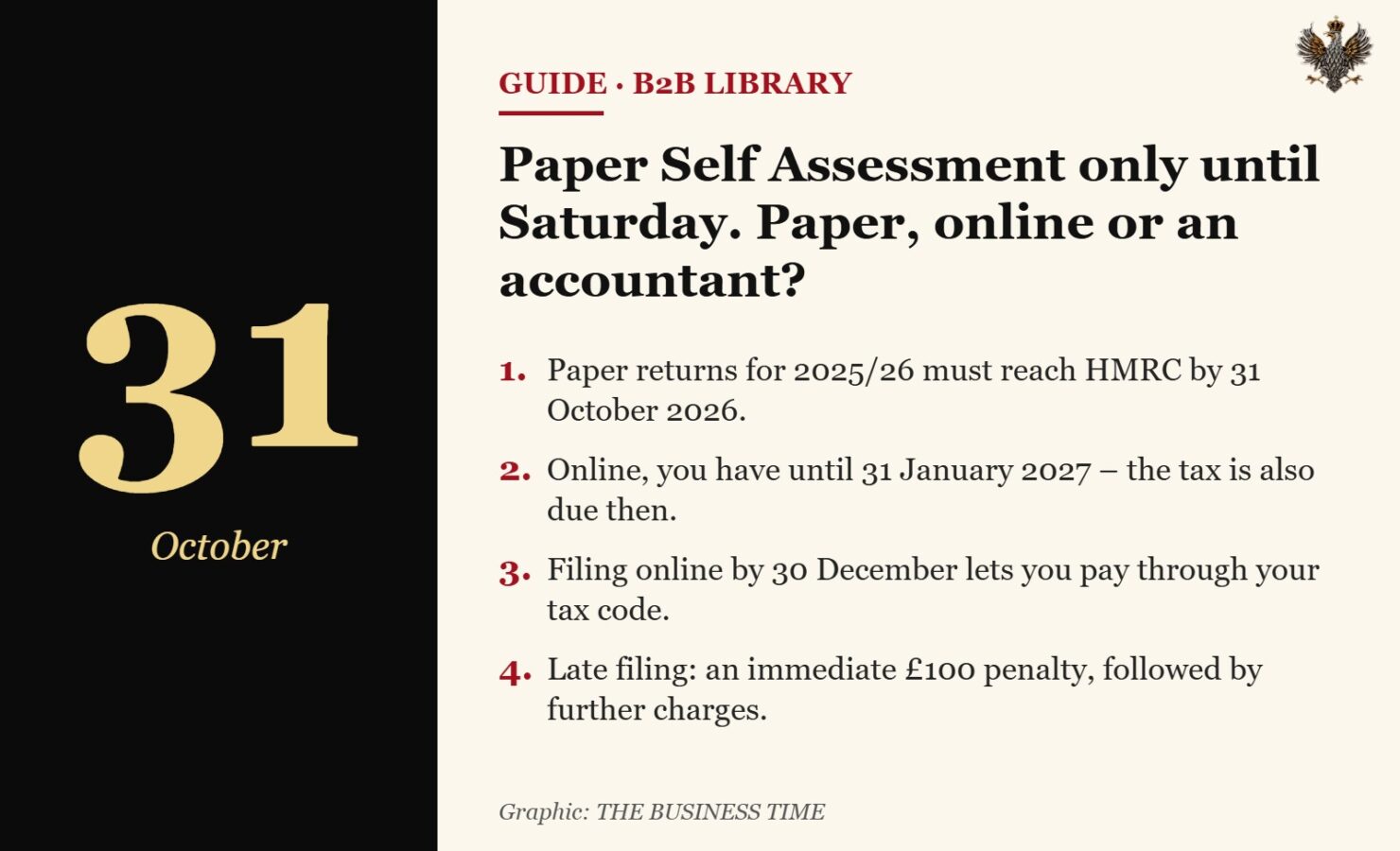
On Saturday 31 October 2026 at 11:59pm the deadline passes for paper Self Assessment returns for the 2025/26 tax year (6 April 2025 to 5 April 2026). HMRC counts the date it receives the form, not the date it was sent. A letter posted today may not arrive in time.
This applies, among others, to the self-employed, partners in partnerships, directors with additional income and people who let out a flat. If you cannot make the paper deadline, there is no need to panic: an online return can be filed until 31 January 2027. The tax must be paid by the same day.
The problem
Many small businesses still choose paper because “it has always been done that way”. Paper now gives you less time, and this year the deadline falls on a Saturday. You need to decide quickly how you will file your return.
Possible solutions
1. A paper return by 31 October. Pros: you know the form and get it out of the way at once. Cons: it must reach HMRC by Saturday, so if you post it the risk of being late is high. You also do not see the tax calculation straight away.
2. An online return by 31 January 2027. Pros: three more months, the system calculates the tax for you, and you get a confirmation. Cons: you need an HMRC online account and some time for the first login.
3. An online return by 30 December 2026 and payment through your tax code. If you also work as an employee (PAYE) or receive a pension, HMRC can collect the tax you owe in instalments from your pay. The condition: an online return by 11:59pm on 30 December 2026. Pros: you do not pay the whole amount at once. Cons: lower take-home pay during the next tax year.
4. An accountant. Pros: fewer mistakes and someone keeps track of deadlines, reliefs and expenses. Cons: it costs money, and January is accountants’ busiest month.
Our recommendation
If your paper return is not already in the envelope, we would choose the online route. Three extra months are a real gain, and filing before 30 December gives you the additional option of paying through your tax code. We would not, however, leave the return until the last week of January.
The decision is yours
Paper makes sense if the form is ready and you can get it to HMRC by Saturday. An accountant is the better choice if you have several sources of income, rental income, income from Poland or doubts about expenses. In your own case, it is worth confirming the details with an accountant or tax adviser.
What being late costs
- For a late return: an immediate £100 penalty.
- After 3 months: £10 a day, up to a maximum of £900.
- After 6 and after 12 months: each time 5% of the tax due or £300 (whichever is higher).
- For late payment: 5% of the unpaid tax at 30 days, at 6 months and at 12 months, plus interest.
What to do
- Check your deadlines on GOV.UK: Self Assessment – deadlines.
- If you do not have an online account, set one up now rather than in January: GOV.UK: filing your return online.
- If you want to pay the tax from your wages, file online by 30 December 2026.
- Penalties and appeals (if you have a reasonable excuse): GOV.UK: Self Assessment – penalties.
Sources: GOV.UK – Self Assessment tax returns: deadlines; GOV.UK – Self Assessment tax returns: penalties (as of 28 October 2026).
We assess factual corrections and substantive responses. Verified changes are reflected in our reporting.
Contact the editorial desk →