Poland’s Ministry of Finance has published a draft of a new regulation on access to the National e-Invoicing System (KSeF). The news was reported on 28 October 2026 by Rzeczpospolita and the Prawo.pl website.
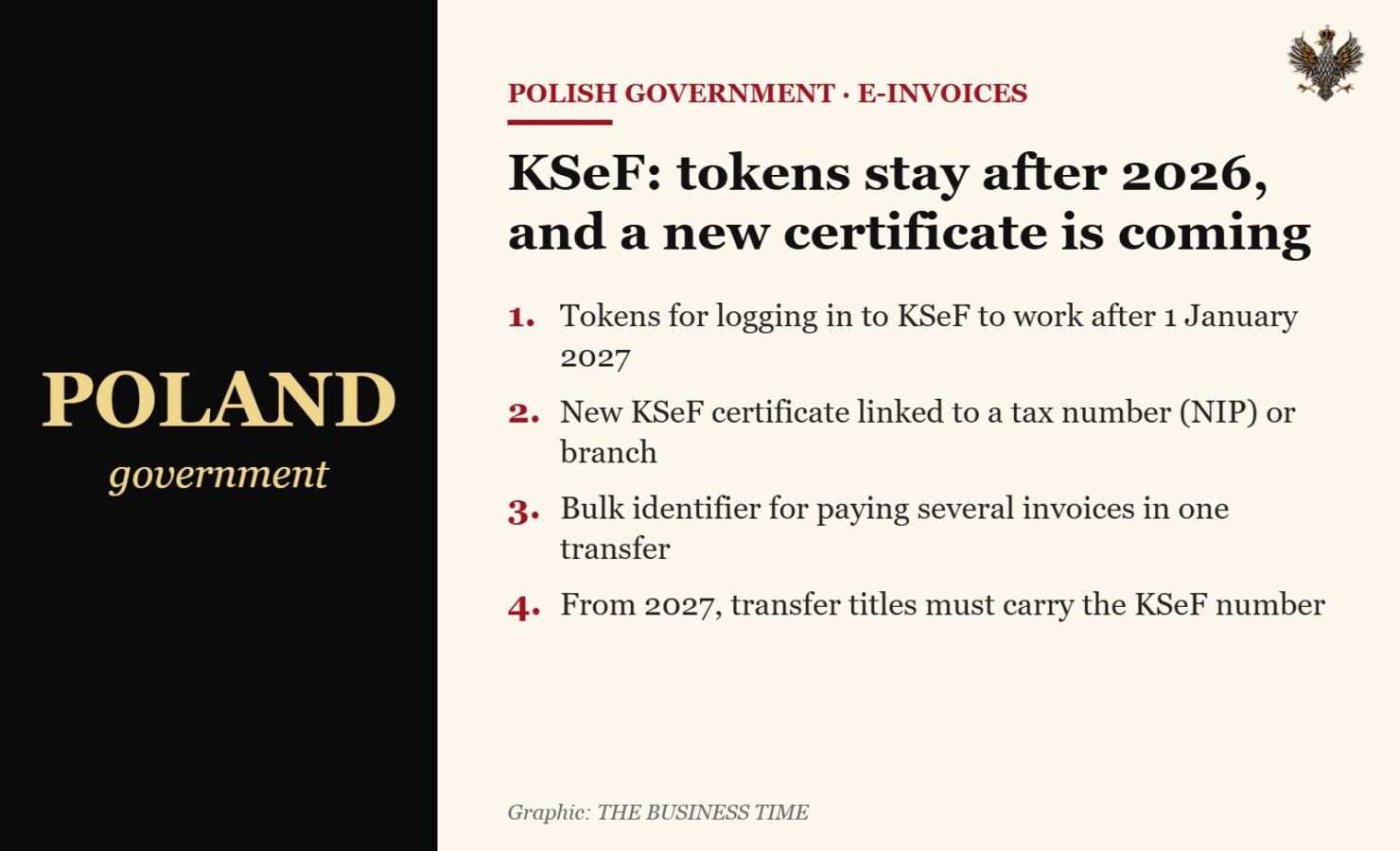
The most important change concerns tokens – the codes that businesses and accounting firms use to log in to KSeF, often through invoicing software. Under the current rules, tokens were to work only until the end of 2026. The draft allows them to be used after 1 January 2027 as well. The ministry has not yet given an end date.
The draft also introduces a KSeF certificate. A business will be able to generate it within the permissions it already holds in the system. The certificate can be issued for a tax identification number (NIP) or for a company branch. It can also be limited to a specific relationship – for example, an accounting firm logs in only on behalf of one client, but it must still hold that client’s authorisation.
The third change is a bulk identifier. It marks a transfer with which a business pays for several e-invoices at once. From 1 January 2027, active VAT payers will have to include the KSeF invoice number or such a bulk identifier in the transfer title.
What it means for Poles in the UK
This affects Poles in the UK who run a business in Poland, have a branch there or sell to Polish customers as active VAT payers in Poland. If an accounting firm in Poland handles the invoices, the new certificate will make it easier for it to act on behalf of a client living in the UK.
What it means for you
- Small businesses: if you log in to KSeF with a token through your software, you do not need to rush to change how you log in before the end of the year.
- Payments: from 2027, transfers paying invoices will have to include the KSeF number or a bulk identifier. It is worth preparing your accounting system and bank for this.
- Accounting firms: a certificate limited to one client reduces the risk of mistakes and misuse.
Our assessment
This is good news for businesses. Some entrepreneurs had already started spending money on new login methods because tokens were due to disappear. The draft may still change, but the direction is clear: fewer sudden changes and more time. The key date is 1 January 2027 – the obligation to include the KSeF number in transfers already follows from the VAT Act.
What to do
- Check how your invoicing software connects to KSeF and whether the provider plans to support the certificate: ksef.podatki.gov.pl.
- Ask your bank and accountant how to enter the KSeF number or bulk identifier in the transfer title from 2027.
- For your own situation, confirm the details with an accountant or tax adviser.
Sources: Rzeczpospolita (28 October 2026); Prawo.pl (28 October 2026).
We assess factual corrections and substantive responses. Verified changes are reflected in our reporting.
Contact the editorial desk →