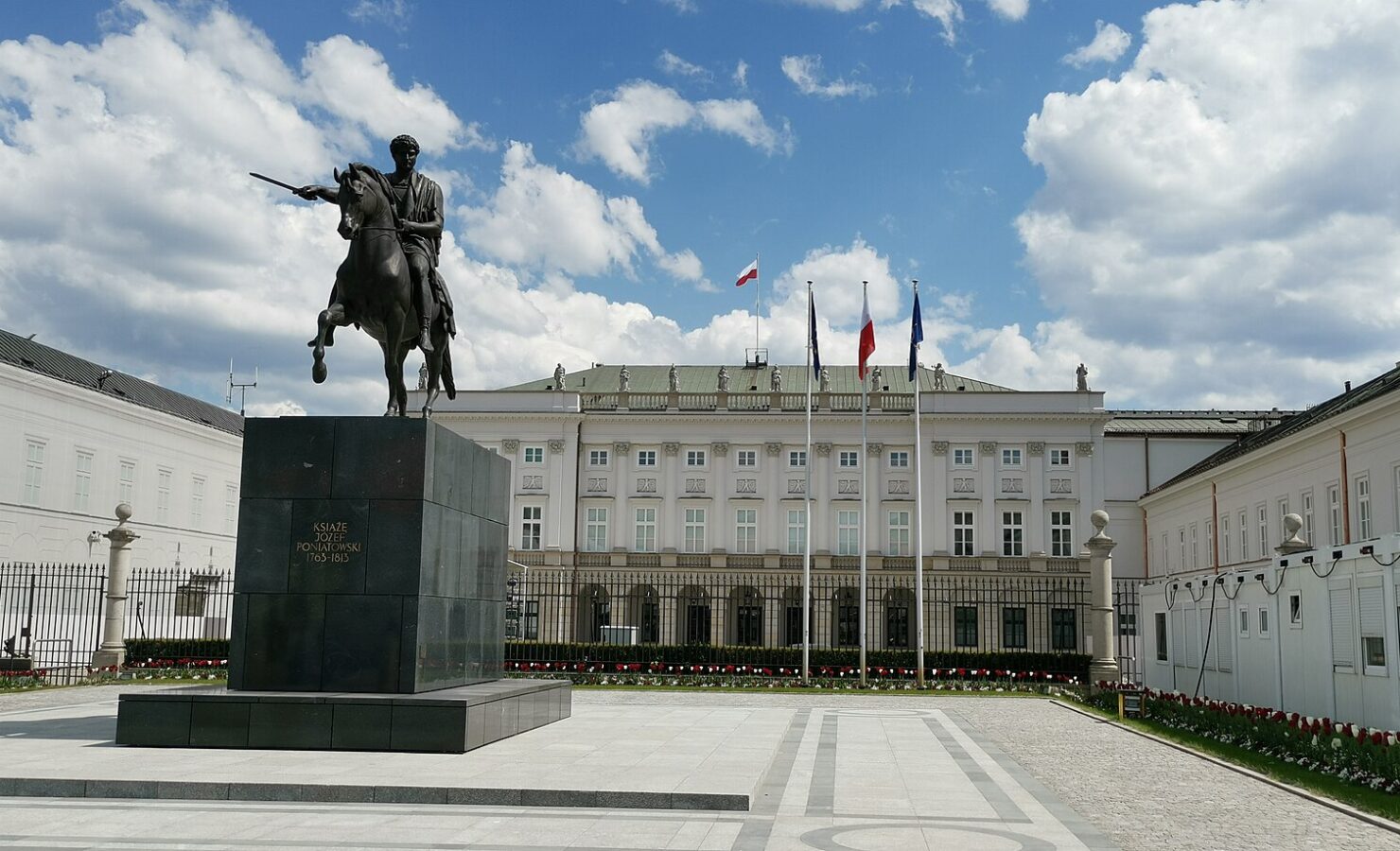
The dispute over Poland’s Constitutional Tribunal reached the National Security Council (RBN) on Tuesday 3 November. President Karol Nawrocki convened the meeting at the Presidential Palace. Those attending included Prime Minister Donald Tusk, the speakers of the Sejm and Senate, the defence and foreign ministers, military commanders and representatives of parliamentary groups.
Officially the council was to discuss security and plans for a permanent US military base in Poland. The President’s Office said, however, that events around the Tribunal would also be on the agenda.
The president’s position
Only the president spoke in the open part of the meeting. He described a “serious constitutional crisis” and a situation “without precedent”. In his view, on the night of Friday to Saturday before All Saints’ Day the government “tried to unlawfully take over the Tribunal”, using police officers and the State Protection Service. He said the prime minister bears responsibility and that he would use all his prerogatives.
In the evening, Marcin Przydacz, head of the president’s International Policy Office, called Tuesday’s gathering of some Tribunal judges a “farce”.
The prime minister’s position
Donald Tusk did not speak on camera during the council. At a press conference afterwards he said the president’s speech was “probably unnecessarily confrontational” and “had nothing to do with reality”. In his view, doubts about the Tribunal stem from the president not swearing in judges elected by the Sejm.
The prime minister offered the president a one-to-one meeting this week, with the date and place kept secret. Presidential spokesman Rafał Leśkiewicz replied that the president had repeatedly declared his readiness to meet the prime minister and that a date would be announced once agreed.
What happened at the Tribunal and the Supreme Court
On the same day some Tribunal judges met in a General Assembly convened by Judge Anna Korwin-Piotrowska. According to Wirtualna Polska, eight judges attended. They decided they had a quorum, adopted the Tribunal’s 2027 budget and drew disciplinary panels in the cases of Tribunal President Bogdan Święczkowski and Judge Sochański. Mr Święczkowski, the President’s Office and the First President of the Supreme Court dispute the validity of that assembly.
At the Supreme Court, the judges’ assembly passed no resolution: 28 judges boycotted it and there was no quorum. In the evening, “A light for the Tribunal” vigils were held in several cities.
Where both sides agree
Defence Minister Władysław Kosiniak-Kamysz said after the meeting that the council confirmed a shared priority of the government and the president: a permanent US military base in Poland. He called for calm and respect for the law over the Tribunal.
What it means for Poles in the UK
Our view: day to day, the dispute does not change the situation of Poles in the UK, but it increases legal uncertainty in matters that may reach the Tribunal.
- Consulates and documents unchanged. Passports, ID cards, civil records and cases in Polish courts are handled as before. The dispute is about who lawfully runs the Tribunal, not the everyday work of public offices.
- Tribunal rulings in question. When two sides disagree about who is a judge and who heads the Tribunal, future rulings may not be recognised by one of them. This matters for people whose cases involve, for example, tax, pension or family law – it is worth asking a lawyer whether a given ruling is being applied by courts and offices.
- The coming days are key. Both sides say they are ready to talk. The outcome of the meeting between the president and the prime minister will show whether tension eases before Independence Day on 11 November.
We will continue to report on the dispute, setting out the arguments of both sides.
Sources:
We assess factual corrections and substantive responses. Verified changes are reflected in our reporting.
Contact the editorial desk →