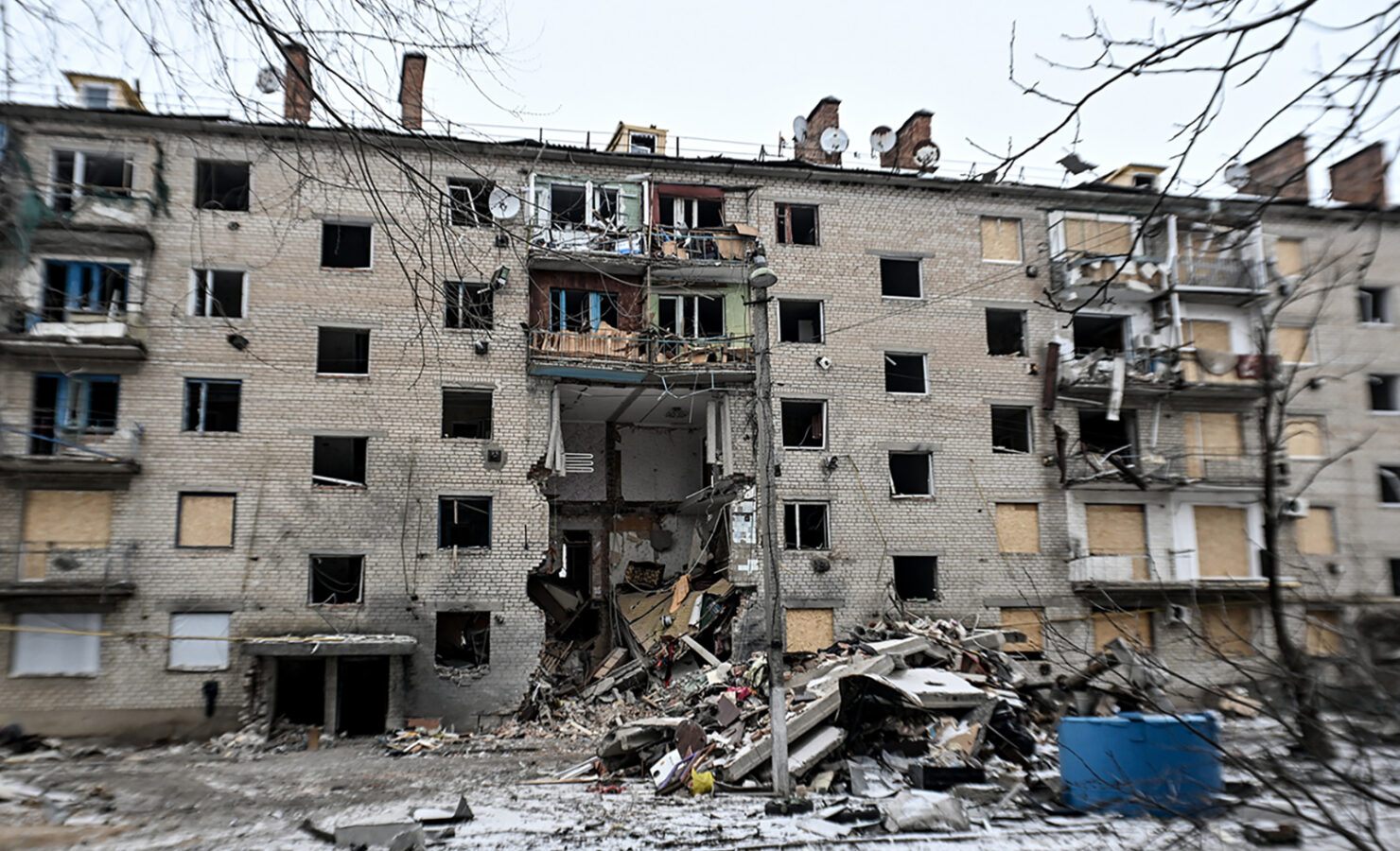
The UN Human Rights Monitoring Mission in Ukraine (HRMMU) published a statement on Tuesday 3 November about the attack on the village of Komyshuvakha in Zaporizhzhia region. According to the mission, by Tuesday evening local authorities had confirmed at least 31 civilians killed and five injured. Ukrainian officials and media give higher figures – the Kyiv Independent reported on Tuesday at least 33 dead, including rescuers and police officers, while regional governor Mykhailo Semikin said 48 people were missing. The UN says it is still verifying the figures.
What happened
The attack took place on the morning of Monday 2 November. The first strike hit a school where humanitarian aid was handed out to residents every week. According to local authorities, nine aerial bombs fell on the village in two waves. The Kyiv Independent reports that further strikes hit a shelter where people had taken cover, as well as rescuers and police who had arrived to help.
Komyshuvakha lies about 20 km from the front line. President Volodymyr Zelensky called it an “exceptionally horrific strike” and said Russia could not have been unaware that aid was distributed there. In the sources we used, there was no comment from the Russian side by Tuesday evening.
Glide bombs – a weapon killing more and more
According to the UN, glide bombs were used: large bombs dropped from aircraft, fitted with wings and sometimes guidance. They can travel up to 100 km from the release point and carry hundreds of kilograms of explosives. Even before this attack, glide bombs had killed at least 478 civilians and injured 2,667 in Ukraine in 2026 – 16 per cent of all verified civilian casualties this year.
What the law says
The head of the mission, Danielle Bell, said the attack “seems to have violated the most fundamental principles of international humanitarian law”. These are the principles set out in the Geneva Conventions and their Additional Protocols: distinction (only military targets may be attacked, not civilians), proportionality and precautions. The UN also notes that repeated strikes on the same location greatly increase casualties, because they hit people gathering after the first blast, including rescuers.
The UN assessment is not a verdict. Criminal responsibility for war crimes can be decided by national courts and the International Criminal Court. UN mission documentation can, however, serve as evidence in such proceedings.
What it means for Poles in the UK
Our view: after tragedies like this, the wish to help grows – and so does the number of fake fundraisers. Help is worthwhile, but through verified organisations.
- Check the charity on the register. Charities in England and Wales can be checked free of charge on the Charity Commission register on GOV.UK. Scotland and Northern Ireland have their own registers.
- Be wary of social media appeals asking for transfers to private accounts or in cryptocurrency.
- Take care when sharing photos and videos of the attack – old or manipulated material also circulates online. Rely on UN statements and credible media.
The attack comes as preparations continue for further talks on ending the war. We will report on the findings of the UN investigation.
Sources:
We assess factual corrections and substantive responses. Verified changes are reflected in our reporting.
Contact the editorial desk →